


Soil and Plant Nutrient Ratios for Better Plant Growth
This article is based on peer-reviewed research published in New Phytologist (Bell et al., 2014), examining how nutrient ratios shape plant–microbe interactions in the rhizosphere.
The Hidden Balance Driving Plant Growth
Healthy plant growth isn’t just about how much fertilizer you apply—it’s about balance.
At the center of this balance is a powerful concept:
the ratio of carbon (C), nitrogen (N), and phosphorus (P) across plants, soils, and microbes.
These nutrient ratios—known as stoichiometry—regulate how nutrients move through soil, how microbes function, and ultimately how efficiently plants grow and perform.
What Are Nutrient Ratios (C:N:P)?
Every living system depends on a balance of key elements:
- Carbon (C) → energy and structure
- Nitrogen (N) → proteins and vegetative growth
- Phosphorus (P) → energy transfer (ATP), genetics, and flowering
The ratio of these elements determines how efficiently biological processes operate.
In soil systems, this balance exists across three tightly connected components:
- Plants
- Soil
- Microbial communities
Together, they form the rhizosphere—the most biologically active zone in agriculture.
The Rhizosphere: Where Nutrient Cycling Happens
The rhizosphere is the narrow region of soil surrounding plant roots—and it’s where most nutrient exchange occurs.
Within this zone:
- Plants release carbon compounds into the soil
- Microbes use that carbon for energy
- Microbes produce enzymes that unlock nutrients
- Nutrients cycle back to the plant
This creates a tightly linked system where plants, microbes, and soil chemistry continuously influence one another.
What Our Research Explored
Our study examined whether nutrient ratios are consistent—or vary—across different plant species in nature.
We measured:
- Plant tissue C:N:P ratios
- Soil nutrient ratios
- Microbial biomass ratios
- Enzyme activity related to nutrient acquisition
All within species-specific rhizospheres in a natural grassland system.
Key Finding #1: Most Systems Operate Within a Stable Range
One of the most important findings:
Most plant species did not create dramatically different nutrient ratio environments.
Despite differences in plant type, many rhizospheres showed:
- Similar soil nutrient balances
- Similar microbial activity patterns
- Comparable enzyme-driven nutrient cycling
What this means
There appears to be a baseline biological operating range that governs healthy soil systems.
Key Finding #2: Some Plants Reshape Nutrient Dynamics
While most systems were similar, a few plant types stood out:
- C4 grass (Buchloe dactyloides)
- Legume (Astragalus laxmannii)
These species created distinct nutrient environments within their rhizosphere, including:
- Higher microbial carbon activity
- Lower available soil nitrogen
- Altered decomposition and nutrient mineralization patterns
Why this matters
Certain plants can actively reshape microbial behavior and nutrient cycling, influencing overall system performance.
What This Tells Us About Soil Biology
This research reinforces a key principle:
Soil biology is structured, responsive, and directly influenced by plant systems.
Nutrient ratios influence:
- Which microbes thrive
- Which enzymes are produced
- How quickly nutrients cycle
- Which nutrients become limiting
Even small shifts in C:N:P balance can significantly change how the system functions.
Why Nutrient Ratios Matter for Plant Growth
For growers, this translates into a practical shift:
It’s not just about adding nutrients—it’s about maintaining the right balance.
When nutrient ratios are balanced:
- Microbial activity becomes more efficient
- Nutrient cycling improves
- Plants access nutrients more effectively
When ratios are off:
- Microbes compete with plants
- Nutrients become locked up
- Fertilizer efficiency declines
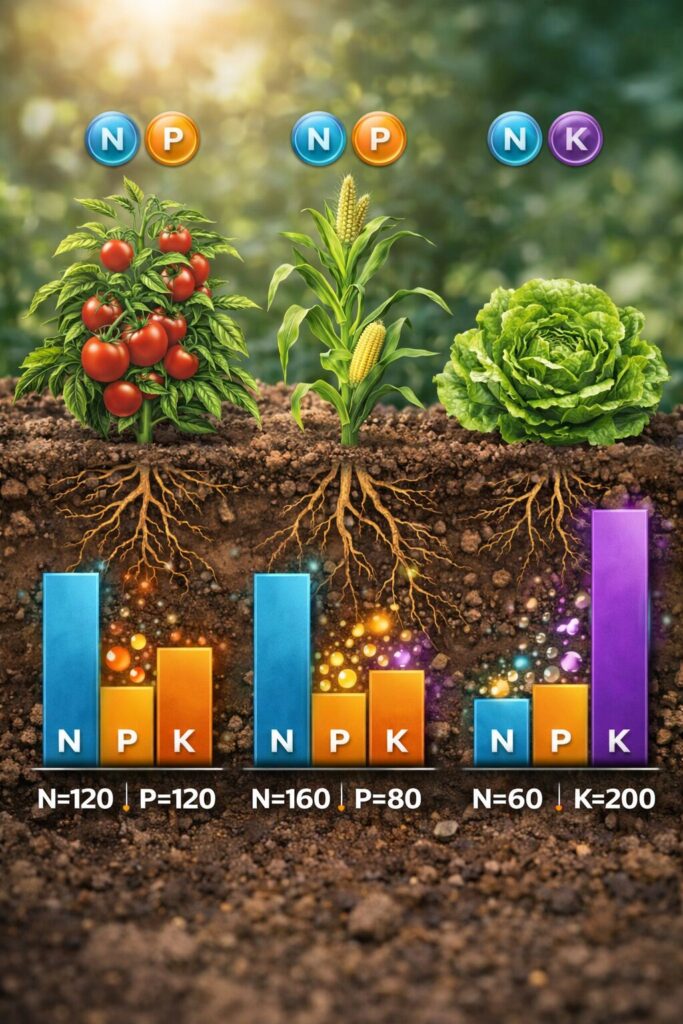
Microbes act as the regulatory engine of nutrient balance.
The Role of Microbes in Nutrient Balance
Microbes act as the regulatory engine of nutrient balance.
They respond by:
- Producing enzymes to access limiting nutrients
- Adjusting metabolism based on C, N, or P availability
- Regulating nutrient release into plant-available forms
Microbes don’t just react to imbalance—they actively stabilize the system.
A Better Way to Think About Plant Nutrition
This research points toward a more advanced approach to plant nutrition.
Instead of:
- “Add more nitrogen”
- “Increase phosphorus”
A better approach is to ask:
- What is the current nutrient ratio?
- What is limiting the system?
- How are microbes responding?
This represents a shift from input-based agriculture → biology-driven agriculture.
The Takeaway
Soil and plant nutrient ratios are a powerful—but often overlooked—driver of plant performance.
Key insights:
- Most soils operate within a stable biological balance
- Certain plants can shift microbial and nutrient dynamics
- Microbes respond directly to nutrient imbalances
- Nutrient efficiency depends on ratios—not just quantity
Simple Summary
Balanced systems drive better growth, efficiency, and yield
C:N:P ratios regulate plant growth and soil biology
Plants, microbes, and soil are tightly interconnected
Most systems are stable—but some plants shift nutrient dynamics
Microbes adjust enzyme production based on nutrient demand
See the full scientific article (below):
Rhizosphere stoichiometry: are C : N : P ratios of plants, soils, and enzymes conserved at the plant species-level?
Bell, C., et al. (2014). New Phytologist 201(2): 505–517.







Leave a Reply