


Nitrogen Does More Than Feed Plants
This article is based on peer-reviewed research published in Soil Biology & Biochemistry (Bell et al., 2015), demonstrating how plant nitrogen uptake drives rhizosphere microbial community assembly.
The Rhizosphere: A Dynamic Nutrient Battleground
The rhizosphere is the narrow zone of soil surrounding plant roots—and one of the most competitive environments in nature.
In this zone:
- Plants absorb nutrients like nitrogen
- Microbes compete for the same resources
- Nutrient availability constantly shifts
This creates a dynamic system where plants and microbes are tightly linked through nutrient demand.
Nitrogen is one of the most important nutrients for plant growth—but its role goes far beyond building leaves and proteins.
Nitrogen doesn’t just feed plants.
It shapes the entire microbial ecosystem around roots.
Research shows that as plants take up nitrogen, they actively influence which microbes thrive in the rhizosphere—changing how nutrients cycle and how efficiently plants grow.
What Our Research Explored
This study examined how plant nitrogen uptake influences rhizosphere microbial communities over time.
Plants were grown under controlled conditions, and researchers tracked:
- Soil nitrogen availability
- Plant tissue nitrogen levels
- Microbial biomass and composition
- Enzyme activity related to nutrient acquisition
Measurements were taken across multiple stages of plant growth to capture how the system evolves.
Key Finding #1: Plant Nitrogen Uptake Shapes Microbial Communities
One of the most important findings:
Plant nitrogen uptake strongly predicts which microbes dominate the rhizosphere.
As plants absorb nitrogen:
- Soil nitrogen availability declines
- Microbial communities shift in response
- Only microbes adapted to lower-nitrogen conditions persist
What this means:
Plants are not passive—they actively select their microbial partners by changing nutrient availability.
Key Finding #2: Nitrogen Competition Drives Microbial Selection
During peak plant growth:
- Plants rapidly draw down nitrogen from the soil
- Microbial biomass nitrogen decreases
- Competition for nitrogen intensifies
This creates a strong selection pressure:
- Microbes that tolerate low-nitrogen conditions persist
- Others decline or are outcompeted
Bottom line:
Nitrogen availability acts as a biological filter shaping the microbial community.
Key Finding #3: Microbial Function Shifts with Nitrogen Availability
As nitrogen becomes limited, microbes adjust their function:
- Increased production of nitrogen-acquiring enzymes
- Higher enzyme C:N ratios
- Shifts in overall nutrient cycling dynamics
This reflects a core principle:
Microbes respond to nutrient limitation by changing function—not just population.
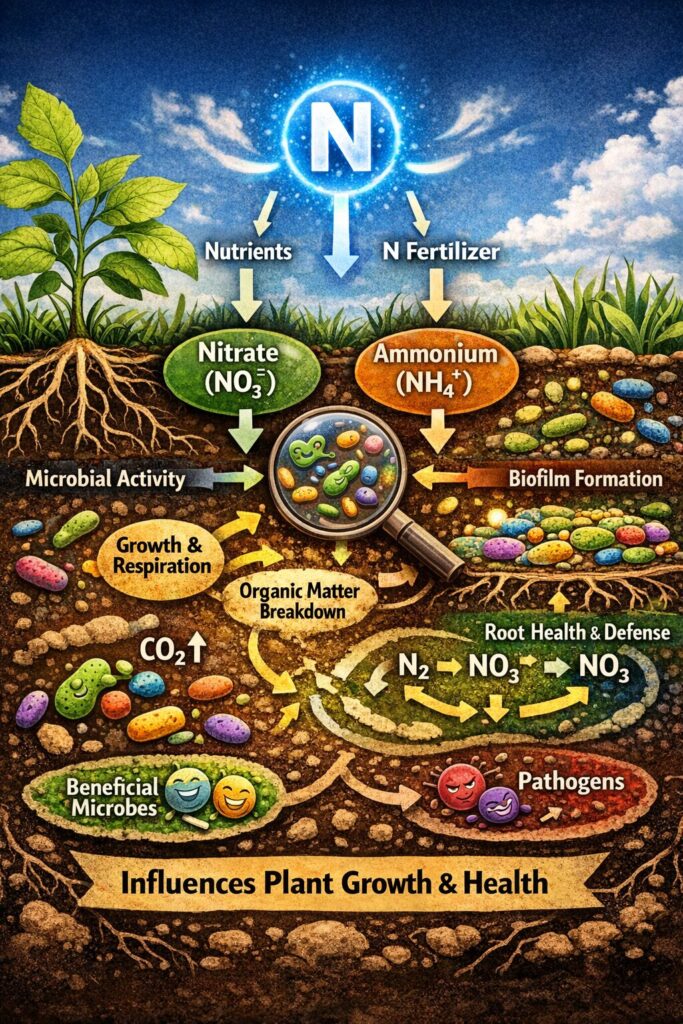
Why Nitrogen is the Essential Element for Plant Growth
A Powerful Insight: Plants Engineer Their Microbiome
One of the most important takeaways:
Plants influence their microbiome by controlling nutrient availability.
By taking up nitrogen, plants:
- Alter soil chemistry
- Create selection pressure on microbes
- Shape rhizosphere structure and function
Microbial community assembly is not random—it is a plant-driven selection process.
Why This Matters for Plant Growth
These interactions directly impact plant performance.
When nitrogen is efficiently cycled:
- Nutrient availability is more consistent
- Microbial activity supports plant uptake
- Growth becomes more stable and productive
When nitrogen is depleted or imbalanced:
- Microbial competition increases
- Nutrients become less available
- Growth efficiency declines
Implications for Growers
This research shifts how we think about nitrogen management.
It’s not just about how much nitrogen you apply—it’s about how nitrogen flows through the system.
Key insights:
- Rapid nitrogen uptake can reshape microbial communities
- Microbes respond to nitrogen limitation by adjusting enzyme activity
- Plant–microbe competition influences nutrient efficiency
A better approach:
Instead of simply increasing inputs, consider:
- How quickly nitrogen is being used
- Whether microbes are competing for nitrogen
- How soil biology is responding
A Shift Toward Biology-Driven Agriculture
This research highlights a broader shift in agriculture:
From:
- Input-driven systems (add more nutrients)
To:
- Biology-driven systems (manage nutrient cycling)
Understanding plant–microbe interactions around nitrogen helps unlock:
- Greater nutrient efficiency
- More resilient growing systems
- Improved long-term soil health
The Takeaway
Nitrogen is more than a plant nutrient—it is a driver of microbial community structure and function.
Key insights:
- Plant nitrogen uptake shapes rhizosphere microbial communities
- Declining soil nitrogen creates strong selection pressure
- Microbes adapt by shifting enzyme activity and function
- Plants indirectly engineer their microbiome through nutrient demand
Summary
Plant–microbe interactions are driven by nutrient dynamics
Nitrogen uptake by plants changes the soil environment
Microbial communities shift in response to nitrogen availability
Competition for nitrogen determines which microbes persist
Microbes adjust enzyme production under nitrogen limitation
See the full scientific article (below):
Plant nitrogen uptake drives rhizosphere bacterial community assembly during plant growth
Bell, C.W., et al. (2015). Soil Biology & Biochemistry, 85, 170–182.






Leave a Reply