

Why Phosphorus Matters
Phosphorus (P) is a crucial nutrient, driving plant growth, health, and productivity. It supports root development, disease resistance, nutrient absorption, flower production, and bud potency (e.g., cannabinoid and terpene content).
This white paper explains how P works in cannabis, the challenges of ensuring its availability, and practical solutions to boost its use, with a focus on sustainable practices for indoor and outdoor growers.
How Phosphorus Drives Growth
Phosphorus powers essential processes in cannabis plants, especially during the flowering stage when energy demands are high for dense, potent buds:
- Energy for Growth: P is part of adenosine triphosphate (ATP), which fuels photosynthesis, converting sunlight into energy for plant growth (Marschner, 2012).
- Nutrient Absorption: ATP helps roots pull in nutrients like nitrogen and potassium, even against natural barriers in soil or water (Marschner, 2012).
- Cell Building: P forms cell membranes and metabolic compounds, supporting healthy leaves, stems, and flowers.
- Genetic Health: P links DNA and RNA, which carry and read genetic instructions for cannabis development and seed production.
Without enough P, plants grow slowly, show dark green, blue-green, or purple/reddish leaves (unlike nitrogen deficiency, which causes yellowing), develop weak stems, brown necrotic spots, delayed flowering, and produce lower yields with reduced potency. Controlled studies show phosphorus deficiency significantly reduces plant growth, biomass accumulation, and overall plant performance (Cockson et al., 2019).
Table 1: Phosphorus Deficiency vs. Healthy Plants
| Characteristic | P-Deficient Plant | Healthy Plant |
| Growth Rate | Stunted, slow | Vigorous, steady |
| Leaf Color | Dark green, blue-green, purple/reddish | Green |
| Stem Strength | Weak, brittle | Strong, supportive |
| Yield | Reduced, lower biomass and yield potential | Optimal, high potency |
| Disease Resistance | Weak | Strong |
| Necrosis | Brown, dead spots on older leaves | None |
| Flowering | Delayed, slower maturity | Timely, robust |
Challenges in Delivering Phosphorus to Plants
Phosphorus is hard to deliver effectively due to local issues in cultivation systems:
- Binding in Media: Up to 70% of P fertilizer binds to soil, peat, or coco within hours, especially in acidic soils (pH < 6.0), becoming unusable (Mahdi et al., 2012).
- Overuse: Growers often apply extra P to compensate, wasting resources and risking runoff. Excess nutrients and imbalances in the root zone can interfere with phosphorus uptake and efficiency (Marschner, 2012).
- Cold Temperatures: Temperatures below 60°F (15°C) reduce P uptake by slowing plant metabolism.
- Water Quality: Hard water or contaminants can block P uptake, causing nutrient imbalances.
- Poor Growing Medium: Compacted or low-quality soil limits root access to P.
Using Beneficial Bacteria to Boost Phosphorus
Beneficial bacteria can unlock P for plants, improving growth and sustainability:
- Unlocking P: Phosphate-solubilizing bacteria convert mineral-bound phosphorus into usable plant-available forms (Mahdi et al., 2012; Pang et al., 2024). Microbial inoculants have been shown to improve phosphorus availability and uptake efficiency across multiple cropping systems (Conant et al., 2017, Mahdi et al., 2012; Pang et al., 2024).
- Recycling Organic P: Microbes mineralize organic phosphorus, converting it into usable phosphate, making it available to roots.
- Improving Efficiency: Microbial activity can increase the fraction of applied phosphorus that plants actually use.
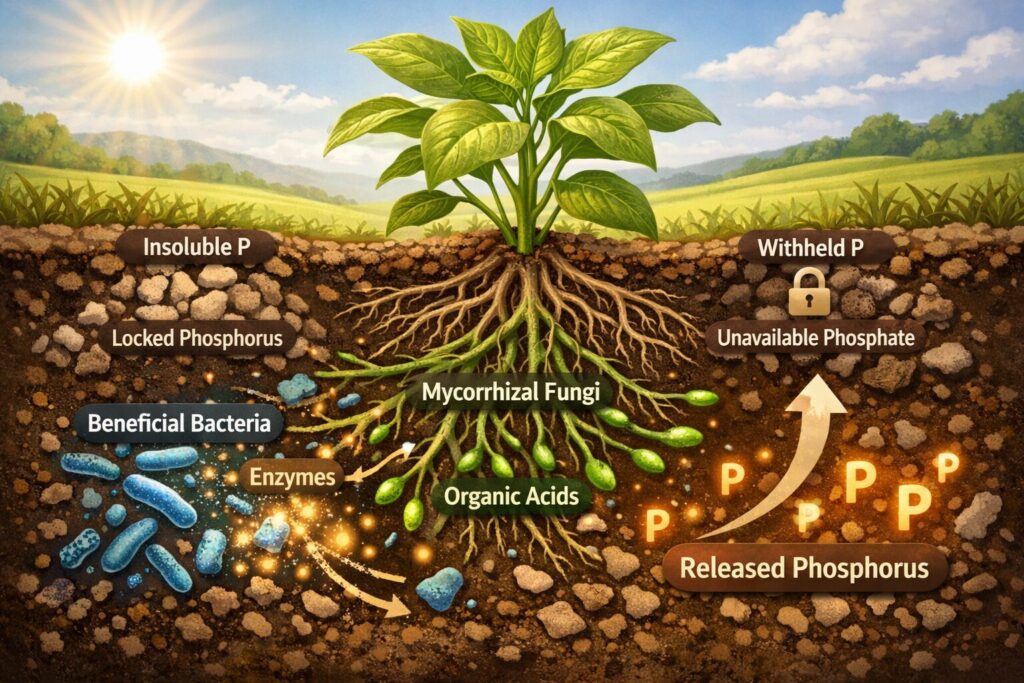
Beneficial bacteria unlock P, improving plant uptake efficiency
How to Use Bacteria Effectively
- Choose Products: Select certified bacterial products with proven P-unlocking ability, verified by third-party testing.
- Apply Early: Mix bacteria into irrigation water at planting or seedling stage for best root contact. Phosphorus needs may vary by strain; for example, some varieties often require slightly higher P than others.
- Monitor Risks: Avoid overapplication (follow product labels). Monitor plant responses and P levels to adjust dosing.
Case Studies: Phosphorus in Action
The following studies illustrate phosphorus management in diverse cultivation systems:
Case Study 1: Phosphorus Deficiency Reduces Physiological Performance
A controlled study on Cannabis sativa examined plant responses under low phosphorus conditions (5–15 mg/L P). Researchers found that phosphorus deficiency significantly reduced:
- Photosynthesis rates
- Stomatal conductance
- Transpiration
These physiological limitations directly impact plant growth and productivity.
Key insight:
Phosphorus is not just a structural nutrient—it directly drives energy metabolism and carbon assimilation, especially during flowering (Shiponi & Bernstein, 2021).
Case Study 2: Increasing Phosphorus Efficiency is Critical to Increase Yield
Multiple controlled-environment cannabis studies have tested increasing phosphorus levels in hydroponic systems (Westmoreland & Bugbee, 2022).
- Increasing P from ~25 → 75 mg/L significantly increased phosphorus accumulation in plant tissues
- However, no increase in flower yield or cannabinoid concentration was observed
- Excess P led to 12× higher phosphorus runoff (leachate)
Key insight:
Efficiency—not excess—is the key driver of plant performance and yield.
Case Study 3: Optimal Phosphorus Range Drives Yield Response
In hydroponic cannabis production systems, yield responds to phosphorus in a non-linear (quadratic) manner:
- Yield increases as P rises to an optimal range
- Beyond that range, additional phosphorus provides no benefit
One study identified an optimal nutrient range, with phosphorus contributing to a defined yield response curve under controlled conditions (Bevan et al., 2021).
Key insight:
There is a tight optimal window for phosphorus—too little limits growth, too much wastes input without improving output.
Case Study 4: Phosphorus Directly Influences Cannabinoid Biology
Research shows phosphorus availability impacts secondary metabolism in cannabis:
- P affects biosynthesis pathways tied to cannabinoids
- Nutrient availability influences flower development and chemical composition
Key insight:
Phosphorus management is not just about yield—it also influences quality and biochemical expression (Shiponi & Bernstein, 2021; Bernstein et al., 2019–2021).
Case Study 5: Nutrient Deficiency Symptoms Confirm Functional Limits
Controlled nutrient omission studies show that phosphorus deficiency leads to:
- Stunted growth
- Leaf discoloration and necrosis
- ~79% reduction in tissue phosphorus levels compared to healthy plants
Key insight:
Deficiency symptoms reflect severe internal limitations in nutrient status and metabolism (Cockson, P., et al. 2019).
What These Studies Prove (Clear Takeaways)
1. Phosphorus is essential—but tightly regulated
- Deficiency reduces photosynthesis and growth
- Adequate supply is required for normal plant function
2. Overapplication is common—and ineffective
- Increasing P beyond optimal levels does not increase yield
- Excess phosphorus that is not effectively utilized can lead to environmental losses and reduced system efficiency.
3. Efficiency is the real opportunity
- Optimal performance comes from:
- Correct P range
- Improved uptake and utilization
- Better root-zone biology and dynamics
Summary and Next Steps
Phosphorus is a constituent of major compounds in the plant cells, such as nucleic acids and phospholipids, and it also plays a central role in energy transformations and as an energy carrier. It is therefore required for many key metabolic processes (Hawkesford, M., et al. 2012). Phosphorus plays a central role in plant growth, yield development, and metabolic function. Beneficial microbes can improve phosphorus availability and nutrient use efficiency, supporting more consistent plant performance. Growers should test media, use clean water, maintain warm temperatures, apply bacteria, and monitor levels to optimize results.
Table 2: Key Takeaways
| Aspect | Key Point |
| Phosphorus Role | Fuels growth, nutrient uptake, genetics, and bud potency |
| Challenges | 70% binding, overuse, cold temperatures, water quality, poor media |
| Solution | Use beneficial bacteria to improve phosphorus availability and nutrient use efficiency |
| Action | Test pH, use clean water, keep above 60°F, apply bacteria, monitor levels |
FAQs
Why is phosphorus so important for cannabis growth?
Phosphorus is crucial because it fuels energy metabolism, supports root development, enhances nutrient absorption, and influences flower production and potency in cannabis plants.
What are the signs that my cannabis plant is deficient in phosphorus?
Signs of phosphorus deficiency include dark green, blue-green, or purple/reddish leaves, slow growth, weak stems, brown necrotic spots, delayed flowering, and reduced yields with lower potency.
Why is phosphorus hard to deliver effectively to cannabis plants?
Phosphorus is hard to deliver because it often binds to soil or growth media, becomes unusable, and is affected by factors like overuse, cold temperatures, water quality issues, and poor growing media.
How can beneficial bacteria help with phosphorus availability?
Beneficial bacteria can convert mineral-bound phosphorus into forms that plants can absorb, mineralize organic phosphorus, and improve the efficiency of phosphorus uptake, supporting healthier growth.
What are the best practices for using bacteria to improve phosphorus uptake?
Choose certified bacterial products, apply early at planting or seedling stage, and monitor plant responses and phosphorus levels to ensure effective and safe application.
References
Conant, R., et al. (2017). “Conant et al., J Hortic 2017, 4:1 DOI: 10.4172/2376-0354.1000191TM, on Cannabis sativa Bud Yield.” J Hortic 4(191): 2376–0354.1000191. DOI: 10.4172/2376-0354.1000191
Dhillon, J., et al. (2017). World phosphorus use efficiency in cereal crops. Agronomy Journal.
Marschner, H. (2012). Marschner’s Mineral Nutrition of Higher Plants (3rd ed.). Academic Press.






Leave a Reply